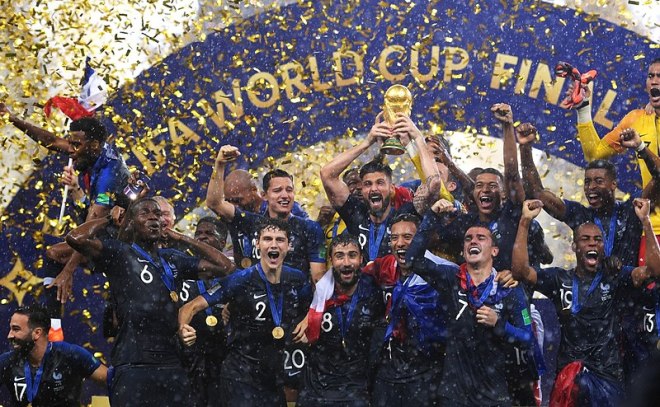
1586 days until we can do it all again. Qatar, the world is waiting.
This summer has provided fans with a World Cup like no other- an unprecedented success, which has never been shy of drama and fan feelings of utopia.
Russia could be defined as the stage where the heavyweights of international football punched below their expectations, or perhaps where the lesser lights raised the bar to levels not yet reached nor imagined.
‘Favourites to win’ was a term that soon became obsolete with each match that passed, as the giants of the game fell like dominoes, one by one.
The holders of the World Cup, Germany, made an early exit after failing to progress from their group which included South Korea, Sweden and Mexico- who could have foreseen this being on the horizon? Brazil, the firm favourites to go the distance and capture Die Mannschaft’s throne, were ousted by Belgium in the quarter-finals.
Yet this is only half of the story.
2018 was the first World Cup since 1930 whereby neither Brazil or Germany were in the semi-finals of the tournament- the mighty had fallen.
Hosts Russia exceeded expectations both off and on the pitch: not only were they responsible for staging a sublime month of football, they were on the brink of a semi-final place after knocking out 2010 winners Spain on penalties in the Round of 16; though they couldn’t withstand the test of Croatia in the quarter-finals. The highly successful Croats made their way to their first ever World Cup final, with their golden generation of players, which included the likes of Luka Modric, Ivan Perisic, Ivan Rakitic, Dejan Lovren and Mario Mandzukic.
We may fail to see a World Cup quite like this for some time. This was the year for underdogs to prevail, unpredictability to reign supreme and drama to soar to unprecedented levels.
A nation brought to a standstill:
After years of hurt, England fans finally have a major tournament they can walk away from feeling proud.
The anguish and hurt following their Euro 2016 demise at the hands of Iceland proved to be a vivid reminder of the lack of passion, talent and ideas that was holding a team of talented players back from reaching their true potential. However, the appointment of Gareth Southgate appeared to bring instantaneous change, which would prove to have unimaginable implications.
This time around, there was a much greater sense of camaraderie within the 23-man squad; this was the year for new faces to come to the fore and attempt to do something the old guard couldn’t manage. Having been filled with familiar faces such as Steven Gerrard, Frank Lampard, Wayne Rooney and Joe Hart, Russia presented the opportunity for the next generation of England players to provide a glimpse of what was to come in the future. In the end, it was much more than a glimpse of hope they issued- Southgate’s men provided a fairy-tale journey which seemed as though it would last a lifetime.
In recent years, the apparent lack of enthusiasm and desire to win showcased by the national team has left many in England feeling out of touch with a group of players who would continue to perform consistently at club level, yet always fall short on the international stage. The likes of Harry Maguire, Kieran Trippier and Jordan Pickford became the unlikely heroes, a trio who few would have imagined viewing in this manner. This group of players had not been through years of heartache and turmoil- these were young, hungry players who were lurking in the shadows and ready to reignite hope for a nation scarred by years gone by.
Gareth Southgate proved to the world that it’s not all about past experience and reputation, as he changed the views of many who doubted his initial appointment.
Recent predecessors such as Roy Hodgson and Fabio Capello struggled to grab the support of the nation, as people began to feel disconnected as time went by. Southgate on the other hand, managed to breathe new life into this side and changed the way they played. England have been associated with a rather negative style of play- a hit and hope kind of approach- but this was all to change in Russia. The football was exquisite at times; fast- paced, intricate and well-worked. This was a side that had been well disciplined and stuck to their gameplan.
Off the pitch, Southagte came across just as assured but maintained a calm and fair tone to his words- this was a manager the fans could finally relate to and get on board with.
It was clear to see just how much people were taking to this England side. The semi-final defeat to Croatia was the most watched British television event in six years, with approximately 26 million viewers tuning in to ITV. Prior to this, England’s quarter-final clash versus Sweden drew in 19.9 million watching on the BBC, with a further 3.8 million also tuning in on the BBC IPlayer- the highest figure recorded for online viewing on the BBC. Meanwhile, the Round of 16 tie against Colombia also attracted 23.8 million spectators at peak viewing.
“It’s coming home”, the soundtrack for England at Euro 1996 began to sweep across the nation. There was a sense of optimism in the air. The impossible dream was moments away from becoming an unfathomable reality. Southgate and his players can head home proud of what they have achieved.
Football may not be coming home but it’s certain that new found confidence and an injection of belief to go one step further in 2022 is returning from Russia.
Time doesn’t wait for anyone- even the very best:
It was another World Cup in which both Cristiano Ronaldo and Lionel Messi failed to win the prestigious trophy which still eludes both players in their never-ending honours list.
At the fourth time of asking, the two greats fell short once more- but just how many more opportunities will come their way to achieve winning this iconic footballing prize?
Ronaldo will be fast approaching his 38th birthday at the next World Cup, while Messi will be 35. Age is slowly creeping on these two superhuman players, for whom it is hard to imagine ever slowing down and not performing at the highest level each time they step foot on the field.
Argentina and Portugal crashed out at the same hurdle, with both nations slipping to defeat in the Round of 16 stage. Messi was tasked with helping his side overcome tricky opposition in France, similarly Ronaldo would shape up against Uruguay in what was also a testing encounter.
France ran out 4-3 victors despite Jorge Sampaoli’s men leading 2-1 at one stage, Portugal on the other hand never seemed to break out of first gear as Edison Cavani’s brace condemned them to defeat.
There were tears from Ronaldo as he fled the field. He now perhaps has accepted that time is running out to claim this coveted piece of silverware. Messi may have one more shot at glory, though both men may well fail to replicate what the greats such as Pele and Maradona did before them.
It’s true that 2022 could mark a changing of the guard. Messi and Ronaldo’s unrivaled legacies simply cannot last a lifetime, especially when bearing the heavy weight of their country’s expectations on their shoulders. The football world has become accustomed to these two titans playing in a league of their own, where there are no limitations to what can be achieved. Though, as age creeps up on the dynamic duo, Qatar could be remembered as the tournament where the likes of Kylian Mbappe, Neymar or Gabriel Jesus stole the headlines, rather than the two usual suspects.
From Russia with love:
It truly has been a World Cup to remember. You only have to look as far as the statistics to back this up.
Out of the 64 games played, there was just one goalless draw ( Denmark vs France), compared to the seven stalemates at the 2014 tournament in Brazil. While 164 goals were plundered in Russia- an average of 2.64 per game.
There has been no shortage of drama throughout the month of relentless football. Russia kick-started proceedings with a thumping 5-0 triumph over Saudi Arabia, setting the tone for the remainder of the tournament.
Portugal and Spain then played out one of the finest spectacles of all in their enthralling 3-3 draw in Sochi. La Roja seemed to be headed for a vital three points in Group B, only for Ronaldo to rocket home a free-kick from distance in the dying embers of the contest. Argentina and France played out a seven goal thriller in their aforementioned Round of 16 contest, in what will arguably go down as the pick of the bunch.
But it wasn’t just the copious amounts of goals that was creating all this excitement: Step forward VAR.
The much maligned system was being tested for the first time at a World Cup and it certainly provided a number of talking points to crank up the anticipation levels.
Australia were one of the first sides to feel the pain of a decision going against them, as France’s Antoine Griezmann was awarded a penalty against the Socceroos in their group stage match, following an independent VAR review, while England were feeling the benefits of the controversial technology, as they collected four penalties for having shirts pulled in the area- something that has over the years become part and parcel of football, though now comes with a much greater risk with the addition of video replays.
There were 22 penalties scored at the tournament, the highest there has ever been in a World Cup, in addition to the 27 goals scored in the 85th minute or later of the match ( excluding extra-time). If that wasn’t enough, there were nine winning goals scored in the 90th minute or later at the 2018 World Cup (excluding extra-time), more than at any other edition of the tournament.
Defenders may have been taking their eyes of the ball- with 43% of the goals scored at the 2018 World Cup coming from set-piece situations (73 of 169), more than at any other World Cup since 1966- but fans around the globe were utterly glued to the action.
Until next time, Qatar.
Tom Cavilla.
 Tom Cavilla